Define the decision
Name the decision and the people affected. Define AI’s role: administration, decision support, or automation.
Explore this step : Define the decisionA leadership framework for consequential AI
When AI shapes a decision, responsibility stays with people. Authentic Intelligence gives leaders a practical framework for deciding where AI belongs—and how to remain accountable.
The framework and forthcoming book by Christopher Law.
The book · Coming January 2027
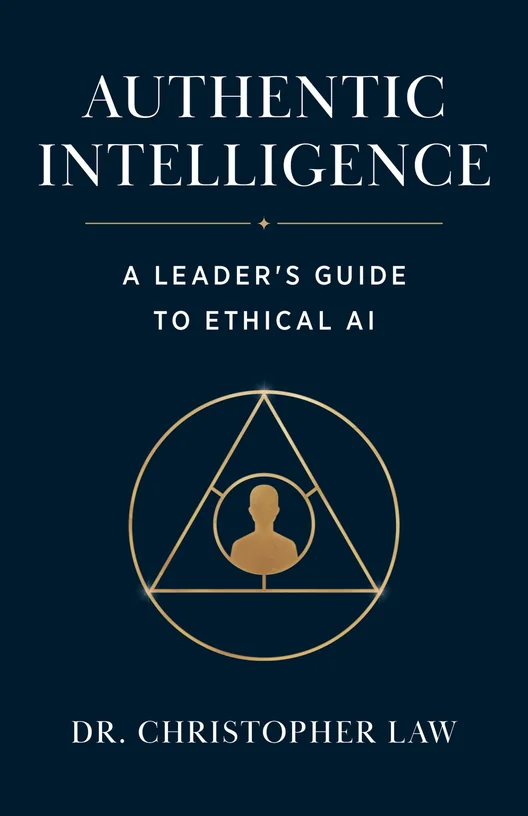
Planned availability. Ordering links coming soon.
Better questions. More accountable decisions. Practical tools in service of the people affected by AI.
The framework
The Authentic Intelligence Model (AIM) helps leaders make their obligations visible when AI shapes consequential decisions. Start with four questions.
Name the decision and the people affected. Define AI’s role: administration, decision support, or automation.
Explore this step : Define the decisionBefore procurement or deployment, ask whether AI should be used for this decision at all.
Explore this step : Run Gate 0Examine Rights, Reasons, and Results across the person, decision professional, and institution or community.
Explore this step : Test the TriangleConsider wider effects on people, communities, the environment, and the systems the organization depends on.
Explore this step : Widen the OrbitRead the full AIM guide“Can we own this AI-shaped decision?”

Free companion workbook
Bring the questions into your next decision. Use the book’s worksheets, scorecards, and governance records with your team. No book purchase needed.
The book
Authentic Intelligence: A Leader’s Guide to Ethical AI grew from Christopher Law’s doctoral research on AI-mediated hiring in financial services. It brings that work to leaders across regulated and trust-sensitive settings.
Protect Rights. Provide Reasons. Monitor Results. Govern vendors, preserve accountability, and offer meaningful recourse. These are the commitments the tools help leaders put into practice.
Meet Christopher LawThe academic foundation
Authentic Intelligence: An Ethical Framework for AI Hiring in Financial Services develops the model through moral philosophy and leadership theory.
Read the public overview, or request the full dissertation for the academic argument and its limitations.
Read the research overviewClear answers
The Authentic Intelligence Model, or AIM, developed by Christopher Law, is a leadership-facing governance framework for deciding whether and how AI should shape consequential decisions. It helps leaders make permission, accountability, explanation, monitoring, vendor control, and recourse visible.
Explore the AIM frameworkThe book and tools are written for executives, boards, and leaders in risk, compliance, legal, technology, product, operations, human resources, and governance—especially in financial services and other regulated or high-stakes environments.
See how a leadership team can use AIMAIM began with AI-mediated hiring in financial services and extends to lending, insurance, claims, fraud, compliance, healthcare operations, utilities, workforce analytics, eligibility, and other decisions where people bear the consequences of error.
Start with the decision and people affectedNo. AIM does not certify that a system is ethical, compliant, safe, or technically valid. It complements legal and regulatory review, privacy, cybersecurity, accessibility, model-risk management, vendor due diligence, audit, and human judgment.
Read AIM’s scope and limitationsPress, industry, and personal inquiries
For media interviews, industry discussions, academic questions, speaking inquiries, or a thoughtful personal note, use the form. Messages go directly to Christopher.